Art On The Wall Across London City

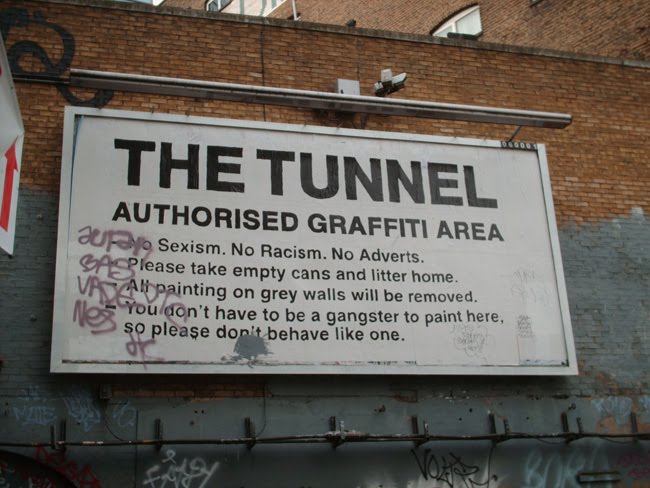
Along with many other cities around the world London has a vibrant and active street art scene.


ADF-ANTI DESIGN FESTIVAL


We are living in an age where millions of colours became 256. Difference is the enemy. Generic culture hypnotises us all into generic patterns, where control is visibly invisible. Danger is replaced by fear. New means upgrade. Risk is obsolete. Art made money stupid, and money made us fools. We welcome no_use, no_function and no_fear. Anarchy, crash and burn, the new awaits.
From Learning to Earning, and now to Yearning, we have forgotten why we are here. We have lost touch with what made us tick, the fire of creative possibility that once consumed us from within.
Revolutionary thought is but a distant memory. I grew up as part of a generation that thought it could help improve society; that our sole function was to be conscious and to spread that consciousness through creative awareness, exploration, observation and questioning.
This generation was replaced by the Thatcher/Reagan paradigm of Culture=Money. Thinkers became earners, Creatives became entertainers, and a whole dumbed-down generation now feels entitled to success and profit without having to work or think too much.
We are now left with a spiritual hollowness. The belief systems of consumption and commodity have been exposed as empty. Revolution is a distant echo lost in the white noise, and religion has been largely subsumed by globalisation. Virtual experiences have replaced human touch. Analogue culture is now the exotic.
We have managed to create for our children, perhaps for the first time in history, a future which is less hopeful than the one we live in today.

Deep Freeze

The house of credit cards has now collapsed. For 25 years we have been in a state of Deep Freeze. We have somehow denied ourselves permission to remember what it was like before the Big Bang of banking deregulation. Schools became businesses and hospitals became profit centres. Art for art’s sake was sacrificed for entertainment and bums on seats. Ideas became clichŽs and anything different was viewed with suspicion and disdain.
We have traded Freedom for Peace. What we need is Liberation.

Free Me From Freedom

As the Lehman Brothers collapsed, so a new era is signalled and the baton is passed on again. Mankind has the opportunity now to reclaim the cultural high-ground and risk something new, a creative breach in the barrier of exclusion that can allow some real growth and evolution, like a bright light shining through the cracks of a crumbling wall.
The line of Dangerous Ideas had been interrupted and the path can be found again.

Dangerous Ideas

When was the last time you encountered any culture that you can say was really dangerous, that actually challenged anything?

3D Animation Exhibition

Beyond the Valley, the fashion store is right now doing a London Design Festival exhibition.

It features 3D illustrations, fashion and an animation movie.

You get to wear one of those red/green googles to see it in full effect.


London design festival


The London Design Festival is a nine-day celebration of design in the world’s creative capital. 
The Festival is a platform for the widest spectrum of design disciplines, brought together as a unique and accessible programme.


V&A Illustration Awards Display 2010
London Design Festival at the V&A
22 Jun 2010 (All day) - 19 Dec 2010 (All day)
Cromwell Road


Serpentine Gallery Pavilion 2010 designed by Jean Nouvel
Serpentine Gallery
10 Jul 2010 (All day) - 17 Oct 2010 (All day)
Kensington Gardens


Jaguar Shoes presents 'The Doorz' by Will Sweeney and Matt Furie
Jaguar Shoes
18 Aug 2010 (All day) - 18 Oct 2010 (All day)
1 & 34 Kingsland Rd, Shoreditch


A Living Space - Curated by Kit Kemp
Contemporary Applied Arts
27 Aug 2010 - 10:00am - 2 Oct 2010 - 6:00pm
2 Percy Street


Talisman Opens New Design Showroom on Ebury Street
Talisman
1 Sep 2010 (All day) - 30 Sep 2010 (All day)
190-192 Ebury Street Discipline:20th Century Design


UNLEASHED DEVICES
Watermans
1 Sep 2010 (All day) - 22 Oct 2010 (All day)
40 High Street Discipline:digital


Must Dash by Paul Boudens
THE WAPPING PROJECT
2 Sep 2010 (All day) - 3 Oct 2010 (All day)
Wapping Hydralic Power Station


Untitled: glass inspired by architecture
Kate Maestri
2 Sep 2010 - 10:00am - 15 Oct 2010 - 5:00pm
58 Marylebone High Street


BLAST! 2010
Zest Contemporary Glass Gallery
9 Sep 2010 (All day) - 6 Nov 2010 (All day)
Roxby Place Discipline:
Glassblowing courses for beginners


The shape of things at flow gallery
9 Sep 2010 (All day) - 6 Nov 2010 (All day)
1-5 Needham Road Discipline:
collecting contemporary craft and design


London Biblio-geography: A Personal A-Z
Few and Far
10 Sep 2010 (All day) - 29 Sep 2010 (All day)
242 Brompton Road Discipline:
Contemporary fashion


The AppLounge
The Applounge
14 Sep 2010 (All day) - 3 Oct 2010 (All day)
100 Wardour Street Discipline:
mobile applications and services
 
museumaker
14 Sep 2010 - 10:00am - 30 Dec 2012 - 12:00am
museumaker @ the Geffrye Museum
Discipline:
commissioning events crafts


14 Sep 2010 - 11:00am - 23 Oct 2010 - 4:00pm
CHELSEA space, 16 John Islip Street
Discipline:
art


15 Sep 2010 - 5:00pm - 3 Oct 2010 - 1:00am
1-3 Wenlock Road
Discipline:
Finnish Design and Food


Viaduct
16 Sep 2010 (All day) - 2 Oct 2010 (All day)
1-10 Summers Street


16 Sep 2010 (All day) - 29 Oct 2010 (All day)
Arts Gallery, University of the Arts London, 272 High Holborn
Discipline:
art


16 Sep 2010 (All day) - 16 Oct 2010 (All day)
114 Kensington Park Road


Matilda Ltd
16 Sep 2010 (All day) - 2 Oct 2010 (All day)
50 Redchurch Street
Discipline:


Studio Toogood
17 Sep 2010 (All day) - 28 Sep 2010 (All day)
North Terrace
Discipline:
creative direction


17 Sep 2010 (All day) - 30 Oct 2010 (All day)
110 Drury Lane


17 Sep 2010 (All day) - 10 Oct 2010 (All day)
Cromwell Road


17 Sep 2010 (All day) - 8 Oct 2010 (All day)
41-71 Commercial Road
Discipline:
education


Creative Heritage - Bodies Beautiful
The African and African-Caribbean Design Diaspora
17 Sep 2010 (All day) - 9 Oct 2010 (All day)
33-35a Clerkenwell Green Discipline:
emerging art and design


London Fashion week 2010


A fashion week is a fashion industry event, lasting approximately one week, which allows fashion designers, brands or "houses" to display their latest collections in runway shows and buyers to take a look at the latest trends. Most importantly, it lets the industry know what's "in" and what's "out" for the season. The most prominent fashion weeks are held in the four fashion capitals of the world - New York City, London, Milan and Paris.

New York, London, Milan and Paris each host a fashion week twice a year with New York kicking off each season and the other cities following in the aforementioned order.
There are two major seasons per year - Autumn/Winter and Spring/Summer. For Womenswear, the Autumn/Winter shows always start in New York in February. Spring/Summer shows start in September in New York. Menswear Autumn/Winter shows start in January in Milan for typically less than a week followed by another short week in Paris. Menswear Spring/Summer shows are done in June. Womenswear Haute Couture shows typically happen in Paris a week after the Menswear Paris shows.
Over the past few years, more and more designers have shown inter-seasonal collections between the traditional Autumn/Winter and Spring/Summer seasons. These collections are usually more commercial than the main season collections and help shorten the customer's wait for new season clothes. The inter-seasonal collections are Resort/Cruise (before Spring/Summer) and Pre-Fall (before Autumn/Winter). There is no fixed schedule for these shows in any of the major fashion capitals but they typically happen three months after the main season shows. Some designers show their inter-seasonal collections outside their home city. For example, Karl Lagerfeld has shown his Resort and Pre-Fall collections for Chanel in cities such as Moscow, Los Angeles and Monte Carlo instead of Paris. Many designers also put on presentations as opposed to traditional shows during Resort and Pre-Fall either to cut down costs or because they feel the clothes can be better understood in this medium.
Some fashion weeks can be genre-specific, such as a Miami Fashion Week (swimwear), Rio Summer (swimwear), Prêt-a-Porter (ready-to-wear) Fashion Week, Couture (one-of-a-kind designer original) Fashion Week and Bridal Fashion Week, while Portland (Oregon, USA) Fashion Week shows some eco-friendly designers.


In 1943, the first New York Fashion Week was held, with one main purpose: to distract attention from French fashion during WWII, when workers in the fashion industry were unable to travel to Paris. This was an opportune moment - as for centuries designers in America were thought to be reliant on the French for inspiration. The fashion publicist Eleanor Lambert organized an event she called ‘Press Week’ to showcase American designers for fashion journalists, who had previously ignored their works. The Press Week was a success, and, as a result, magazines like Vogue (which were normally filled with French designs) began to feature more and more American innovations. Until 1994, shows were held in different locations, such as hotels, or lofts. Eventually, after a structural accident at a Michael Kors show, the event moved to Bryant Park, behind the New York Public Library, where it remained until 2010, when the shows relocated to Lincoln Center.
However, long before Lambert, there were fashion shows throughout America. In 1903, an NYC shop, called Ehrich Brothers, put on what is thought to have been the country’s first fashion show, to lure middle-class females into the store. By 1910, many big department stores were holding shows of their own. It is likely that American retailers saw that they were called 'fashion parades' in Paris couture salons and decided to use the idea. These parades were an effective way to promote stores, and improved their status. By the 1920s, the fashion show had been used by retailers up and down the country. They were staged, and often held in the shop’s restaurant during lunch or teatime. These shows were usually more theatrical than those of today, heavily based upon a single theme, and accompanied with a narrative commentary. The shows were hugely popular, enticing crowds in their thousands – crowds so large, that stores in New York in the fifties had to obtain a license to have live models. Nowadays, access to NYFW (New York Fashion Week) is by invitation only, and only fashion magazine editors, fashion magazine journalists, models (and ex-models) and celebrities are invited.
Other buyers are restricted to the showrooms/stores and the articles in the magazines




Tate Modern


Tate Modern

The galleries are housed in the former Bankside Power Station, which was originally designed by Sir Giles Gilbert Scott, the architect of Battersea Power Station, and built in two stages between 1947 and 1963. The power station closed in 1981. The building was converted by architects Herzog & de Meuron and contractors Carillion, after which it stood at 99m tall. The history of the site as well as information about the conversion was the basis for a 2008 documentary Architects Herzog and de Meuron: Alchemy of Building & Tate Modern. The southern third of the building was retained by the French power company EDF Energy as an electrical substation (in 2006, the company released half of this holding)


Paul Gauguin , Teha 'amana has many parents , 1893 Photo © The Art Institute of Chicago Gauguin
30 September 2010 – 16 January 2011 

Tate Modern's Turbine Hall, site of The Unilever Series © Tate The Unilever Series: Ai Weiwei
12 October 2010 – 2 May 2011

Gabriel Orozco, Black Kites, 1997  © Courtesy of the artist; Marian Goodman Gallery, New York; Galerie Chantal Crousel, Paris; and kurimanzutto, Mexico City  . Philadelphia Museum of Art. Gift (by exchange) of Mr. and Mrs. James P. Magill, 1997 Gabriel Orozco
19 January – 11 April 2011

Joan Miró, Head of a Catalan Peasant, 1925 © Succession Miro / ADAGP, Paris and DACS, London 2008. Tate Joan Miró: The Ladder of Escape
14 April – 11 September 2011

Gerhard Richter, Reader, 1994 © Gerhard Richter. Courtesy San Francisco Museum of Modern Art Gerhard Richter: Panorama
6 October 2011 – 8 January 2012

Olafur Eliasson, The Weather Project, 2003 © Olafur Eliasson. © 2003 Tate, London The Unilever Series 2011
11 October 2011 – 9 April 2012