

NiKaU Handmade with <3
Mostrando entradas con la etiqueta London. Mostrar todas las entradas
Mostrando entradas con la etiqueta London. Mostrar todas las entradas
El traje de Darth Vader
La puja por el traje de Darth Vader comienza con 263.000 euros
El mítico vestuario del villano de «Star Wars»,
utilizado en «El imperio contraataca», sera puesto a la venta a finales
de noviembre en Londres.

Un traje original de Darth Vader, el lado oscuro de
la fuerza, será puesto a la venta a finales de noviembre en Londres con
un precio de salida de 263.000 euros, informó este
miércoles la casa de subastas Christie's.
Se cree que el traje del malo de la Guerra de las
Galaxias, que incluye el casco y la máscara, fue utilizado para la
segunda entrega de la primera trilogía, El Imperio Contraataca,
en 1980.
Neil Roberts, jefe del departamento de cultura
popular de Christie's, manifestó que «Darth Vader es un personaje que se
define por su vestimenta, que le ha convertido en uno de los personajes
más reconocidos de la historia del cine».
«El atractivo global que tienen las películas de
La Guerra de las Galaxias y el interés que han generado en varias
generaciones, quizás no tienen precedentes en el mundo del cine»,
afirmó.
Roberts consideró que su fuerza icónica está por
encima de la de otras reliquias del cine subastadas por Christie's en el
pasado, como las zapatillas rojas de la Dorothy de El mago de Oz
o un vestido hecho a medida para Audrey Hepburn en Desayuno con
diamantes.
Un porcentaje de la venta del traje de Darth Vader
se donará a una organización británica de investigación sobre el cáncer.
El precio final se conocerá el 25 de noviembre.
Fuente: La Voz de Galicia

Canon Pixma Sound Sculptures from Dentsu London on Vimeo.

Dentsu London has just launched a beautiful project promoting the new line of Canon Pixma printers.
Done in collaboration with the biochemical / photographer Linden Gledhill, the project called "Sound Sculptures" can be considered surreal, capturing paints simply dancing through the waves of sound. All captured with maximum detail and color. The agency came to Linden through its project called "Water Figures", which became known worldwide, and would fit perfectly to the concept "bringing color to life," used by the Canon PIXMA printers.
The photographs and filming took place using a Canon 5D Mark II, Canon EF 100mm Macro USM.
Canon Pixma Sound Sculptures from Dentsu London on Vimeo.




Frieze Projects


Frieze Art Fair is held at Regent’s Park, London
2010 Opening Hours
Thursday 14 October: 11am-7pmFriday 15 October: 11am-7pm
Saturday 16 October: 11am-7pm
Sunday 17 October: 11am-6pm

Frieze Music
Frieze Music is an off-site music programme, in 2010 it will be curated by Sarah McCrory and Sam Thorne.

Projects 
Frieze Projects is a programme of artists’ commissions realised annually at Frieze Art Fair.
Talks 
Frieze Talks is a daily programme of keynote lectures, panel debates and discussions. It is presented by Frieze Foundation and programmed by the editors of frieze magazine.
Film 
Frieze Film is commissioned by Frieze Foundation and is broadcast by Channel 4 during the week of Frieze Art Fair.
Music 
Frieze Music 2010 will present two specially curated nights of very different sounds, one of disco and a second of exquisite song from a singular voice.
Education 
In 2009 Frieze Education once again worked with ReachOutRCA to realize an artist-led programme of events for children and young people.
 Award
Award 
The winner of the 2010 Cartier Award is the Berlin-based artist Simon Fujiwara.
Back to the Future!!!! remastered!!!

We’ve been getting very, very excited about Back to the Future coming back to the cinema.
If you didn’t know, Back to the Future has been completely remastered and to celebrate it’s 25th anniversary, Universal Studios are bringing it back to the cinema. We debuted the HD trailer for it a few weeks ago which you can see below. The movie looks better than ever and we highly recommend that you go and see it while it’s on the big screen.
The movie is also coming to blu ray at the end of October.

Prince Charles Cinema (London)


The Prince Charles Cinema (PCC) is a repertory cinema located in Leicester Place, 40 metres north of Leicester Square in the West End of London. It shows a rotating program of cult, arthouse, and classic films alongside recent Hollywood releases - typically more than ten different films a week on two screens (285 seats downstairs and 104 seats upstairs). It also hosts the sing-a-long version of The Sound of Music, which has been shown on a regular basis for over five years, as well as The Rocky Horror Picture Show and Joseph. The cinema has achieved a cult status amongst fans, sticking out as the only independent cinema in the West End.
History

 Ghost
Ghosthttp://www.princecharlescinema.com/

Gauguin
Tate Modern 30 September 2010 – 16 January 2011
About the exhibition
Gauguin is one of the world's most famous and best-loved artists from the early 20th century. For the first time in the UK in over 50 years, Tate Modern presents an exhibition dedicated to this master French Post-Impressionist, featuring paintings and drawings from around the world. His sumptuous, colourful images of women in Tahiti and beautiful landscape images of Brittany in France are some of the most popular images in Modern art.
Gauguin was the ultimate global traveller, sailing the South Seas, and living in Peru, Martinique, and Paris among other places. This exhibition explores the role of the myths around the man – Gauguin as storyteller, painting himself as a Christ-like figure or even a demon in his own paintings, religious and mythical symbols in his work, and the manipulation of his own artistic identity. It features many of his iconic paintings, including those showing daily village life from the artist's colony of Pont-Aven in Brittany, nude bathers and haystacks in the Breton landscape, and decorative works such as the carved wooden door panels around Gauguin's hut in the Marquesas Islands in French Polynesia.
Gauguin sought to escape European civilisation in the South Seas. Inspired by Tahiti's tropical flora, fauna and island life, he immersed himself in its fast-disappearing local culture to invest his art with deeper meaning, ritual and myth.
Guillermo del Toro signing The Fall Wednesday 06 October 18:00 - 19:00 London Megastore

Guillermo del Toro signing The Fall
Wednesday 06 October 18:00 - 19:00
London Megastore
179 Shaftesbury Avenue, London, WC2H 8JR
Top Hollywood director Guillermo del Toro will be signing his new novel The Fall at the Forbidden Planet Megastore, 179 Shaftesbury Avenue, London, WC2H 8JR, on Wednesday 6th October 6 – 7pm.
In this fantastic sequel to The Strain, humans have been displaced at the top of the food chain, and now understand what it is to be not the consumer, but the consumed. Ephraim Goodweather, director of the New York office of the Centers for Disease control, is one of the few humans who understands what is really happening. Vampires have arrived in New York City, and their condition is contagious. If they cannot be contained, the entire world is at risk of infection. As the Biblical origins of the Ancient ones are gradually revealed, Eph learns that there is a greater, more terrible plan in store for the human race – worse even than annihilation…
Guillermo del Toro came to prominence with cult horror movies such as Chronos and The Devil’s Backbone and made his Hollywood directorial debut with the classic Blade II. Rapidly followed by the box office and critical hit Hellboy and the Oscar-winning Pan’s Labyrinth, del Toro has established himself as one of the leading directors in the genre.
Making future Magic: Ipad light painting from Dentsu London


Making Future Magic: iPad light painting from Dentsu London on Vimeo.
We’ve been making two films with BERG over the summer. This is the first.
It’s an exciting project for us, as it’s the first time we’ve had a proper chance to explore some of the themes and possibilities behind Making Future Magic, with the benefit of the superbrains and hands of some new creative partners Timo Arnall, Jack Schulze and the rest of the BERG team.
The brief and discussions we had in the process of making these films were about some of the aims behind the Making Future Magic strategy – all of which are about expanding the value of the commercial communications we make by approaching things with a particular set of priorities:
To make creative work that is contributory and sensible to its culture and environment; to be exploratory and sensitive with regard to materials and media; to wonder what magical visions (as opposed to the familiar dystopias) of the future of media might look like.
We also talked about the meaning of each three words. “Making”, with its emphasis on craftsmanship, understanding of materials and media, and collaboration;
“Future”, meaning something not seen before, something new and unexpected (not so much sci-fi, as near-future);
and “Magic” – surprising, culturally powerful, unusual, capable of delighting.
One of the major reasons we were keen to work with BERG is the inventive and human approach to materials and media characteristic of all their work. Their response went beyond the hopes and imaginings of the original brief to produce something of astonishing beauty and ingenuity that breathed life into the strategy both conceptually and executionally. For this particular film they invented a technique using long camera exposures to record the iPad moving through space in order to make a stop motion film of 3-d light forms.
Art On The Wall Across London City
Along with many other cities around the world London has a vibrant and active street art scene.


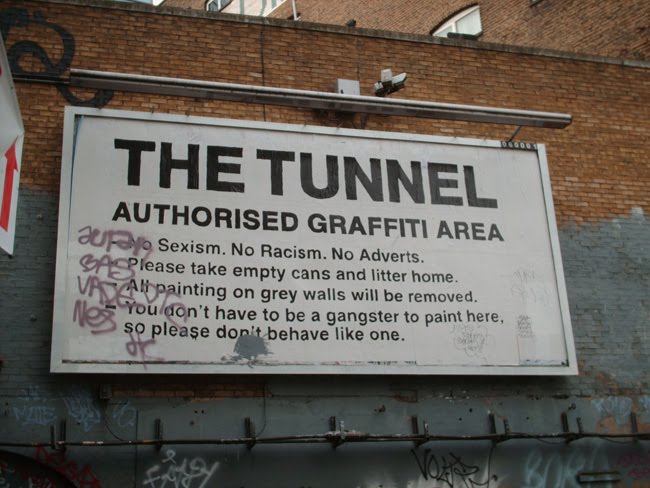


ADF-ANTI DESIGN FESTIVAL

We are living in an age where millions of colours became 256. Difference is the enemy. Generic culture hypnotises us all into generic patterns, where control is visibly invisible. Danger is replaced by fear. New means upgrade. Risk is obsolete. Art made money stupid, and money made us fools. We welcome no_use, no_function and no_fear. Anarchy, crash and burn, the new awaits.
From Learning to Earning, and now to Yearning, we have forgotten why we are here. We have lost touch with what made us tick, the fire of creative possibility that once consumed us from within.
Revolutionary thought is but a distant memory. I grew up as part of a generation that thought it could help improve society; that our sole function was to be conscious and to spread that consciousness through creative awareness, exploration, observation and questioning.
This generation was replaced by the Thatcher/Reagan paradigm of Culture=Money. Thinkers became earners, Creatives became entertainers, and a whole dumbed-down generation now feels entitled to success and profit without having to work or think too much.
We are now left with a spiritual hollowness. The belief systems of consumption and commodity have been exposed as empty. Revolution is a distant echo lost in the white noise, and religion has been largely subsumed by globalisation. Virtual experiences have replaced human touch. Analogue culture is now the exotic.
We have managed to create for our children, perhaps for the first time in history, a future which is less hopeful than the one we live in today.
Deep Freeze
The house of credit cards has now collapsed. For 25 years we have been in a state of Deep Freeze. We have somehow denied ourselves permission to remember what it was like before the Big Bang of banking deregulation. Schools became businesses and hospitals became profit centres. Art for art’s sake was sacrificed for entertainment and bums on seats. Ideas became clichŽs and anything different was viewed with suspicion and disdain.
We have traded Freedom for Peace. What we need is Liberation.
Free Me From Freedom
As the Lehman Brothers collapsed, so a new era is signalled and the baton is passed on again. Mankind has the opportunity now to reclaim the cultural high-ground and risk something new, a creative breach in the barrier of exclusion that can allow some real growth and evolution, like a bright light shining through the cracks of a crumbling wall.
The line of Dangerous Ideas had been interrupted and the path can be found again.
Dangerous Ideas
When was the last time you encountered any culture that you can say was really dangerous, that actually challenged anything?
3D Animation Exhibition
Beyond the Valley, the fashion store is right now doing a London Design Festival exhibition.
It features 3D illustrations, fashion and an animation movie.
You get to wear one of those red/green googles to see it in full effect.


It features 3D illustrations, fashion and an animation movie.
You get to wear one of those red/green googles to see it in full effect.


London Fashion week 2010


A fashion week is a fashion industry event, lasting approximately one week, which allows fashion designers, brands or "houses" to display their latest collections in runway shows and buyers to take a look at the latest trends. Most importantly, it lets the industry know what's "in" and what's "out" for the season. The most prominent fashion weeks are held in the four fashion capitals of the world - New York City, London, Milan and Paris.
New York, London, Milan and Paris each host a fashion week twice a year with New York kicking off each season and the other cities following in the aforementioned order.
There are two major seasons per year - Autumn/Winter and Spring/Summer. For Womenswear, the Autumn/Winter shows always start in New York in February. Spring/Summer shows start in September in New York. Menswear Autumn/Winter shows start in January in Milan for typically less than a week followed by another short week in Paris. Menswear Spring/Summer shows are done in June. Womenswear Haute Couture shows typically happen in Paris a week after the Menswear Paris shows.
Over the past few years, more and more designers have shown inter-seasonal collections between the traditional Autumn/Winter and Spring/Summer seasons. These collections are usually more commercial than the main season collections and help shorten the customer's wait for new season clothes. The inter-seasonal collections are Resort/Cruise (before Spring/Summer) and Pre-Fall (before Autumn/Winter). There is no fixed schedule for these shows in any of the major fashion capitals but they typically happen three months after the main season shows. Some designers show their inter-seasonal collections outside their home city. For example, Karl Lagerfeld has shown his Resort and Pre-Fall collections for Chanel in cities such as Moscow, Los Angeles and Monte Carlo instead of Paris. Many designers also put on presentations as opposed to traditional shows during Resort and Pre-Fall either to cut down costs or because they feel the clothes can be better understood in this medium.
Some fashion weeks can be genre-specific, such as a Miami Fashion Week (swimwear), Rio Summer (swimwear), Prêt-a-Porter (ready-to-wear) Fashion Week, Couture (one-of-a-kind designer original) Fashion Week and Bridal Fashion Week, while Portland (Oregon, USA) Fashion Week shows some eco-friendly designers.
In 1943, the first New York Fashion Week was held, with one main purpose: to distract attention from French fashion during WWII, when workers in the fashion industry were unable to travel to Paris. This was an opportune moment - as for centuries designers in America were thought to be reliant on the French for inspiration. The fashion publicist Eleanor Lambert organized an event she called ‘Press Week’ to showcase American designers for fashion journalists, who had previously ignored their works. The Press Week was a success, and, as a result, magazines like Vogue (which were normally filled with French designs) began to feature more and more American innovations. Until 1994, shows were held in different locations, such as hotels, or lofts. Eventually, after a structural accident at a Michael Kors show, the event moved to Bryant Park, behind the New York Public Library, where it remained until 2010, when the shows relocated to Lincoln Center.
However, long before Lambert, there were fashion shows throughout America. In 1903, an NYC shop, called Ehrich Brothers, put on what is thought to have been the country’s first fashion show, to lure middle-class females into the store. By 1910, many big department stores were holding shows of their own. It is likely that American retailers saw that they were called 'fashion parades' in Paris couture salons and decided to use the idea. These parades were an effective way to promote stores, and improved their status. By the 1920s, the fashion show had been used by retailers up and down the country. They were staged, and often held in the shop’s restaurant during lunch or teatime. These shows were usually more theatrical than those of today, heavily based upon a single theme, and accompanied with a narrative commentary. The shows were hugely popular, enticing crowds in their thousands – crowds so large, that stores in New York in the fifties had to obtain a license to have live models. Nowadays, access to NYFW (New York Fashion Week) is by invitation only, and only fashion magazine editors, fashion magazine journalists, models (and ex-models) and celebrities are invited.
Other buyers are restricted to the showrooms/stores and the articles in the magazines


Suscribirse a:
Entradas (Atom)